Tag: Maths

How to do subtraction decimal in algorithms ?

For this maths activity we took a step up from the last lesson and the step up it was to learn how to subtract two decimal numbers together ! This activity is also very similar to subtracting whole numbers, because all that there is to minusing decimal equations together is that all you have to do is add a decimal point, to the given equation! Something we also learnt during this lesson is that you always have to line up all your decimal points and when subtracting, and the number you can not divide get crossed off and gets replaced with a number in the front of that number, which you have to subtract one from the number in front of the number you have to divide.

I find this activity enjoyable, because it provides me with the opportunity to expand my knowledge.

Data Analysis

For this assignment, we are creating a DLO about data analysis. Data analysis is used to collects and organizing information in order to make useful assessments and decisions.

The objective of this data analysis is to identify the reasons behind LS2’s missed school days. It is evident that sickness is the most preferred option. We also had a conversation about how to prevent it and the negative effects behind for not coming to school. For example one of way you could prevent from it is sleeping early. Because it could support your brain and reduce stress.

I find this activity enjoyable, because it provides me with the opportunity to expand my knowledge.

Decimal Subtraction

LI: How to subtract decimal number using algorithms.

For this task we learned decimal subtraction.

Decimal number is a number that has fractional in it.  For example 4 is a whole number and  4.12 is a decimal number. Because it has 0.12 at the back.  Decimal point is used to separate the whole number and the fractional number.  You just need to line up the Decimal point into columns and subtract all the numbers. Then you place the decimal point between the whole number and the fractional.

I enjoy that activity, because it’s interesting to learn.

Triangle Angles

LI: Understand how to calculate the angles in triangles.

For this task I learned about triangle angles. Angles are the two lines that meet together and have a point.

Triangle angles always have 3 points. There are 3 types of triangle: equilateral triangle, isosceles triangle,  right-angled triangle and scalene triangle. Equilateral triangle means all the points in there are the same degrees. Isosceles triangle means there are only 2 points that have the same angles. Right angle triangles means one corner has 90 degrees.  Scalene triangle means all the points have different angles.

Lastly I made a DLO about triangle angles and gave an example.

I find this activity cool. Because it had been a long time since I made  a DLO about this.

Multiplication Algorithm

L.I: To calculate the sum of whole numbers using algorithms.

L.I: Carry numbers to the next column if needed.

I made a DLO about what is multiplication algorithms and how to do it. Multiplication algorithm doing  multiplication steps by steps. You just split the top number then times the other number. Then you will get the answer.

I find this activity cool. Because it had been a long time not making  a DLO about this.

How to do Short Division


I made a DLO about what is short division algorithm is and how to do it. Short division algorithm is a short short way of writing division. It is the same way of doing long division. The only thing about long division is putting the steps under the number.But short division is putting the numbers in the same line.

I find this activity cool, because I learnt how to use short division.

Revision

This week we revision.

First we make a copy of a math sheet. We did some addition first. After we finished the first one we need to do some word problems and some subtraction word problems. They are different types of them. After finished that we just need to do the challenges.

Next we are going to check our work to see how many were right.

Then we need to find a partner to make a 4 word problems for each other. There must at least have one multiplication, one addition, one division and one subtraction.

At the end I enjoy doing this, because I like it.
 

Identify Fractions

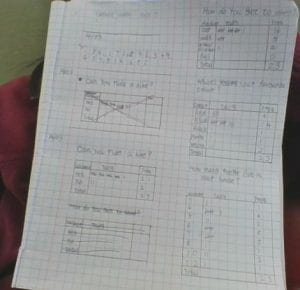
This week we learned about how to identify fractions. The number at the top is called numerator. The number at the bottom is called the denominator.

First we did some fraction to answer some questions.

Then we need to make a DLO to explain how to identify fractions.

At the end I enjoy doing this, because I like it.


Place Value

This week we learned about place value.

First we did a practice.  We draw a “place value house ” and wrote numbers in the columns, so we can get the answer.

Then we did written algorithm. We need to write it on a paper and then take a screenshot of it.

At the end I enjoy doing this, because I like it.
 

Basic Facts Practice 1

This week we learned about Basic Facts Practice 1.

First we need to answer all the queastions.There have addition, subtraction, and multiplication. If we want to challenge ourself we can do the multiplication.

Then we blog it.

At the end I enjoy doing this.Because I like it.